VPP money trail · time-of-use savings
Who pays for time-of-use battery savings
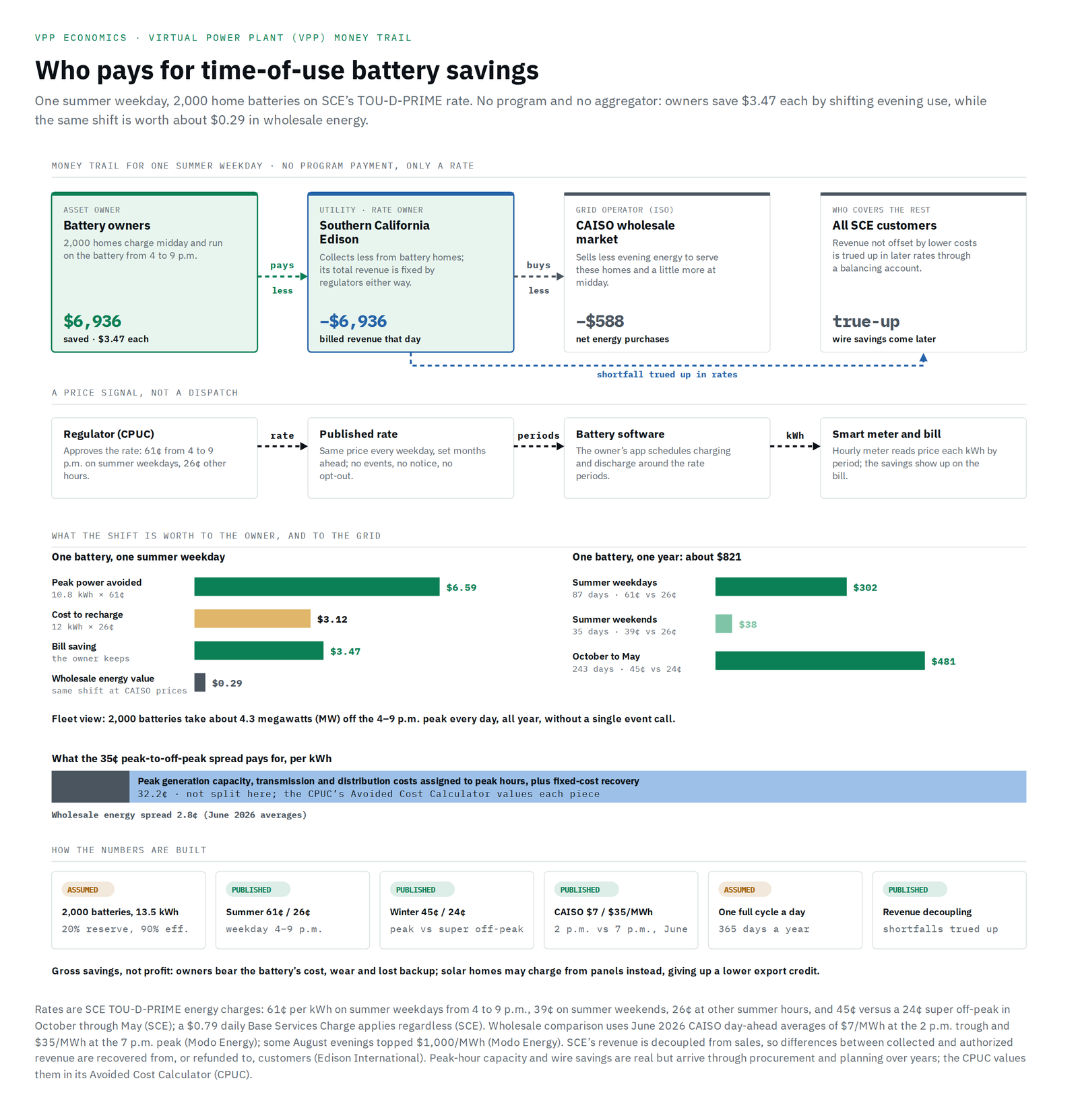
Follow one summer weekday of 2,000 batteries on SCE’s TOU-D-PRIME rate: what owners save, what SCE stops buying from the CAISO market, and who covers the difference.
VPP Economics has no affiliation with, sponsorship from, or endorsement by any utility, aggregator, platform, or device maker named here.
The short answer
- Time-of-use (TOU) savings come from a rate, not a program payment. On SCE’s TOU-D-PRIME rate, power costs 61¢ per kilowatt-hour (kWh) from 4 to 9 p.m. on summer weekdays and 26¢ at other hours (SCE).
- A 13.5 kWh battery that shifts 10.8 kWh a day saves about $3.47 on a summer weekday and about $821 a year. Across 2,000 batteries that is $6,936 a summer weekday, and about 4.3 megawatts (MW) off the evening peak every day.
- The same shift is worth about $0.29 a battery in wholesale energy, using June 2026 California grid operator (CAISO) prices of $7 per megawatt-hour (MWh) at 2 p.m. and $35 at 7 p.m. (Modo Energy). The rest of the 35¢ spread reflects peak-hour capacity and wire costs and fixed-cost recovery.
- No aggregator dispatches anything. The battery responds to a published price; it is load shifting, not demand response (DR) or a virtual power plant (VPP), though the same battery can join one.
Money trail for time-of-use battery savings
Where the money goes when 2,000 batteries on SCE’s TOU-D-PRIME rate shift evening use for one summer weekday. Inputs marked published or assumed.
Swipe to see the full chart →
Step by step
- The regulator (CPUC) approves SCE’s rates, including the gap between peak and off-peak prices. TOU-D-PRIME also carries a $0.79 daily Base Services Charge that no battery can avoid (SCE).
- The battery’s software charges at midday, when power costs 26¢ in summer or 24¢ super off-peak in winter, and powers the home from 4 to 9 p.m. Here each battery keeps a 20% reserve and loses 10% to round-trip efficiency, so it buys 12 kWh to deliver 10.8 kWh.
- The owner pays SCE less. Avoiding 10.8 kWh at 61¢ saves $6.59; recharging costs $3.12; the bill falls by $3.47 for the day.
- SCE buys less evening energy from the CAISO market and slightly more at midday. At June 2026 averages, that saves about $0.29 per battery-day; on hot August evenings real-time prices topped $1,000 per MWh (Modo Energy).
- All SCE customers cover the rest. SCE’s revenue is decoupled from sales: differences between collected and authorized revenue are recovered from, or refunded to, customers (Edison International). Lower peak demand also defers capacity and wire spending over years, which the CPUC values in its Avoided Cost Calculator (CPUC).
Why the bill saving exceeds the energy value
The 35¢ summer spread is a retail price, built to recover the cost of serving peak demand as well as energy. Wholesale energy alone accounts for under 3¢ of it at June 2026 averages. The remainder pays for the generation capacity, transmission and distribution sized for the 4–9 p.m. peak, plus fixed costs spread over peak-hour kWh.
Whether the shift is a fair trade depends on how much of that peak-related cost the battery truly avoids over time. Bill savings that exceed avoided costs are a transfer from other customers; savings that match them are real system value. For a fuller ownership view, see the Battery Economics time-of-use case study.
What it means
Utilities
TOU rates move load every day without a program budget, event calls or measurement and verification. The trade-off is less control: the shift is the same on a mild day as on a crisis day, and the bill impact falls on all customers.
Program managers
A battery on a TOU rate is already doing most of its daily cycle. Adding a VPP or DR program should pay for what TOU does not capture: the rare high-value hours and the battery’s reserve.
Aggregators
TOU arbitrage sets the bar a VPP offer must clear. Dispatch that conflicts with the rate schedule costs the owner money, so the best offers stack on top of TOU rather than replacing it.
All six money trails
PJM demand response event
Capacity is most of the value; owners get a contract share.
See the money trail →Per kWh · one-wayPG&E emergency event
$2 per kWh delivered, passed through to owners.
See the money trail →Flat per devicePSEG Long Island thermostats
$25 a year per device, however many events.
See the money trail →Time-of-use · no programSCE battery on a TOU rate
You are here. Bill savings from a price signal, not a dispatch.
This pageHosted hardwareBase Power home battery
The company owns the battery and keeps the grid value.
See the money trail →Two-way · orchestratedERCOT market-traded fleet
Traded every day; owners get a fixed credit.
See the money trail →Method and caveats
Modeled example: 2,000 batteries of 13.5 kWh with a 20% reserve and 90% round-trip efficiency, cycled once a day; 87 summer weekdays, 35 summer weekend days and 243 October-to-May days. Rates are TOU-D-PRIME energy charges (SCE); solar homes charging from panels would give up an export credit rather than pay 26¢. Wholesale value uses monthly averages and understates peak days.
Gross bill savings are not net profit: owners bear the battery’s cost, wear and lost backup. The split of the spread between capacity, wires and fixed costs is not calculated here. Checked October 16, 2026.