VPP money trail · hosted hardware
Who pays for a hosted home battery
Follow one year of a Base Power battery in a Texas home: what the household pays, what Base passes to Oncor and ERCOT, and how the battery has to pay for itself.
VPP Economics has no affiliation with, sponsorship from, or endorsement by any utility, aggregator, platform, or device maker named here.
The short answer
- In a hosted model, a company owns the battery and keeps the grid revenue; the household hosts it. Base Power’s Oncor-area plan in Texas costs $695 to install and $19 a month, with power at a 7.7¢ energy charge plus delivery (Base Power). This is an illustrative example specific to the Texas grid (ERCOT); upfront costs are lower in other markets. In Illinois (ComEd, in the PJM market), Base lists a $295 installation fee with no monthly battery fee (Base Power), after a $95 offer for its first 2,000 members (Citizens Utility Board).
- The household gets backup for a fraction of a battery’s price. Base compares the $695 with about $13,000 to buy a battery, and keeps at least five hours of backup in reserve at low use (Base Power).
- Base gets a fleet it can trade. As the household’s retailer and the battery’s owner, it buys power in the Texas grid operator (ERCOT) market and dispatches its aggregated fleet every five minutes (Base Power).
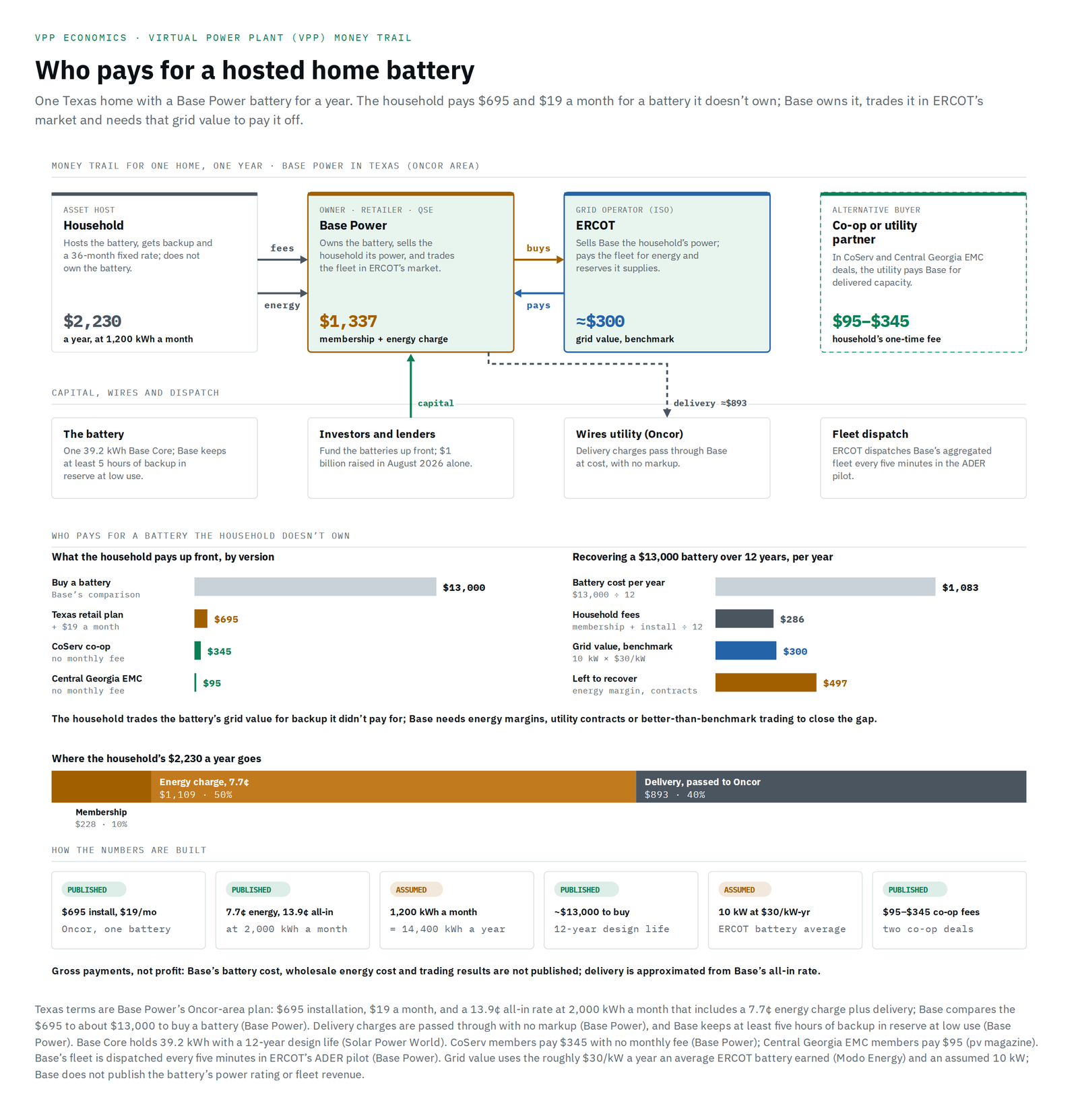
- The battery has to pay for itself through Base. At ERCOT’s average battery revenue of about $30 per kilowatt (kW) a year (Modo Energy) and an assumed 10 kW, grid value covers less than a third of the yearly battery cost; energy margins, utility contracts and trading results fill the rest.
Money trail for a hosted home battery
Who pays whom over one year for a Base Power battery in a Texas home, with capital, wires and dispatch. Inputs marked published or assumed.
Swipe to see the full chart →
Step by step
- Investors and lenders pay for the battery up front. Base raised $1 billion in August 2026 as it began making its 39.2 kWh Base Core in Texas (Reuters; Solar Power World).
- The household pays $695 to install and $19 a month on a 36-month plan, and buys all its electricity from Base: about $2,230 a year at an assumed 1,200 kWh a month (Base Power).
- Base Power passes delivery charges to Oncor, the wires utility, at cost with no markup (Base Power), and buys the household’s energy in the ERCOT market.
- ERCOT pays Base for energy and reserves the fleet supplies. In ERCOT’s aggregated distributed energy resource (ADER) pilot, the fleet is dispatched every five minutes like a power plant (Base Power).
- In utility partnerships, the money changes hands differently: CoServ members pay $345 with no monthly fee (Base Power), and Central Georgia EMC members pay $95 (pv magazine), with the utility paying Base for the capacity it delivers.
Who pays for the battery
Spread over the Base Core’s 12-year design life (Solar Power World), a $13,000 battery costs about $1,083 a year. Household fees cover about $286 of that, and benchmark grid value about $300, leaving roughly $497 a year for retail energy margin, utility contracts and better-than-average trading — or a battery that costs Base less than its retail comparison.
Base does not publish its battery cost, energy margin or fleet revenue, so the gap is an illustration of what the model needs, not a measured shortfall. The structure is clear, though: the household trades the battery’s grid value for backup it did not pay for.
What it means
Utilities
Hosted fleets arrive with financing, installation and dispatch already solved. Co-ops such as CoServ and Central Georgia EMC buy delivered capacity instead of owning batteries or paying customers per kW.
Program managers
When one company owns the asset, sells the power and dispatches the fleet, there is no participant payment to design. Oversight shifts to contract terms: backup reserve, dispatch limits and what happens at contract end.
Aggregators
Owning the hardware captures the full value stack but puts the battery’s cost on the balance sheet. The model depends on cheap capital, high fleet availability and markets — like ERCOT — that pay for fast, flexible response.
All six money trails
PJM demand response event
Capacity is most of the value; owners get a contract share.
See the money trail →Per kWh · one-wayPG&E emergency event
$2 per kWh delivered, passed through to owners.
See the money trail →Flat per devicePSEG Long Island thermostats
$25 a year per device, however many events.
See the money trail →Time-of-use · no programSCE battery on a TOU rate
Bill savings from a price signal, not a dispatch.
See the money trail →Hosted hardwareBase Power home battery
You are here. The company owns the battery and keeps the grid value.
This pageTwo-way · orchestratedERCOT market-traded fleet
Traded every day; owners get a fixed credit.
See the money trail →Method and caveats
Plan terms are Base Power’s Oncor-area pricing (Base Power). Annual household spending assumes 1,200 kWh a month; delivery is approximated as the gap between the 13.9¢ all-in rate and the 7.7¢ energy charge at 2,000 kWh a month, so it is rough at other usage levels. Grid value assumes 10 kW at about $30 per kW a year; Base does not publish the power rating.
The $13,000 battery value is Base’s own retail comparison, not its cost. Gross payments are not net profit for any party. Checked October 16, 2026.