Virtual power plant economics
Every Kilowatt.
Every Market.
Every Dollar.
Batteries, EVs, thermostats, and water heaters can be paid to help the grid at its most expensive hours. VPP Economics follows the money: who gets paid, how much value is created, where that value comes from, and whether joining a virtual power plant makes economic sense for you.
Illustrative only. One home shifting 17 kW of load and supply, repeated across 2,400 enrolled homes, behaves like a 41 MW peaking plant.
The proposition
A VPP is a power plant made of homes.
Somebody gets paid for it.
A virtual power plant (VPP) is a group of devices — batteries, electric vehicle (EV) chargers, thermostats, water heaters, solar systems, and business equipment — that software coordinates to act like one power plant. When demand peaks, the fleet cuts use or supplies power so the grid doesn’t need to fire up, or build, an expensive peaking plant. The U.S. Department of Energy counts roughly 30 gigawatts (GW) of VPPs in the U.S. today and sees room for 80–160 GW by 2030, or 10–20% of peak demand (DOE Liftoff report).
The value is real, but it is split. A grid operator or utility pays for capacity, an aggregator or device maker coordinates the fleet and keeps a share, and the household gets what is left — sometimes a check, sometimes a bill credit, sometimes a free battery. Most sites list programs. We show the money trail.
No sales pitch. No assumption that joining is always the right answer. Just the economics behind the decision.
The assets
Five devices. Very different paychecks.
Home batteries
The most valuable device per home. Fast, precise, and able to export — so programs pay by the kilowatt.
Grid value per device: very high
EV & managed charging
The biggest flexible load in most homes. Today it earns by charging later; bidirectional EVs could export.
Grid value per device: high
Smart thermostats
The largest VPP resource by count. Small payments, but almost no cost to join.
Grid value per device: moderate
Water heating
A tank of hot water is stored energy. Daily shifting can beat once-a-season events.
Grid value per device: high
Solar + storage
Solar alone can’t be dispatched; paired with a battery it becomes the backbone of California’s VPPs.
Grid value per device: high
Ranges are typical published program payments for one device, checked October 1, 2026. Commercial and industrial sites earn far more in total; see C&I Flexibility.
What one device can earn over 10 years
Published program terms, upfront plus ongoing payments, one device per home. Dark bar is the low end; light bar runs to the high end.
Swipe to see the full chart →
Not all “VPPs” are the same
From switching things off to running a power plant.
Many programs called VPPs are traditional demand response: the utility turns devices down a few afternoons a summer. An orchestrated VPP dispatches devices continuously, sometimes into wholesale markets. Pay, frequency, and comfort trade-offs differ at each step.
01
Load control
A radio switch cycles an air conditioner or water heater during emergencies. One-way, blunt, decades old.
e.g. legacy AC switch programs
02
Event-based demand response
Connected thermostats or chargers adjust for 10–20 announced peak events a season. Paid per device or per season.
e.g. thermostat rewards
03
Daily load shifting
Devices shift use every day to cheaper, cleaner hours. Paid monthly, or through time-of-use savings.
e.g. managed EV charging
04
Orchestrated VPP
Software dispatches batteries and other devices as one resource, often bidding into markets. Paid by the kilowatt.
e.g. Connecticut, California batteries
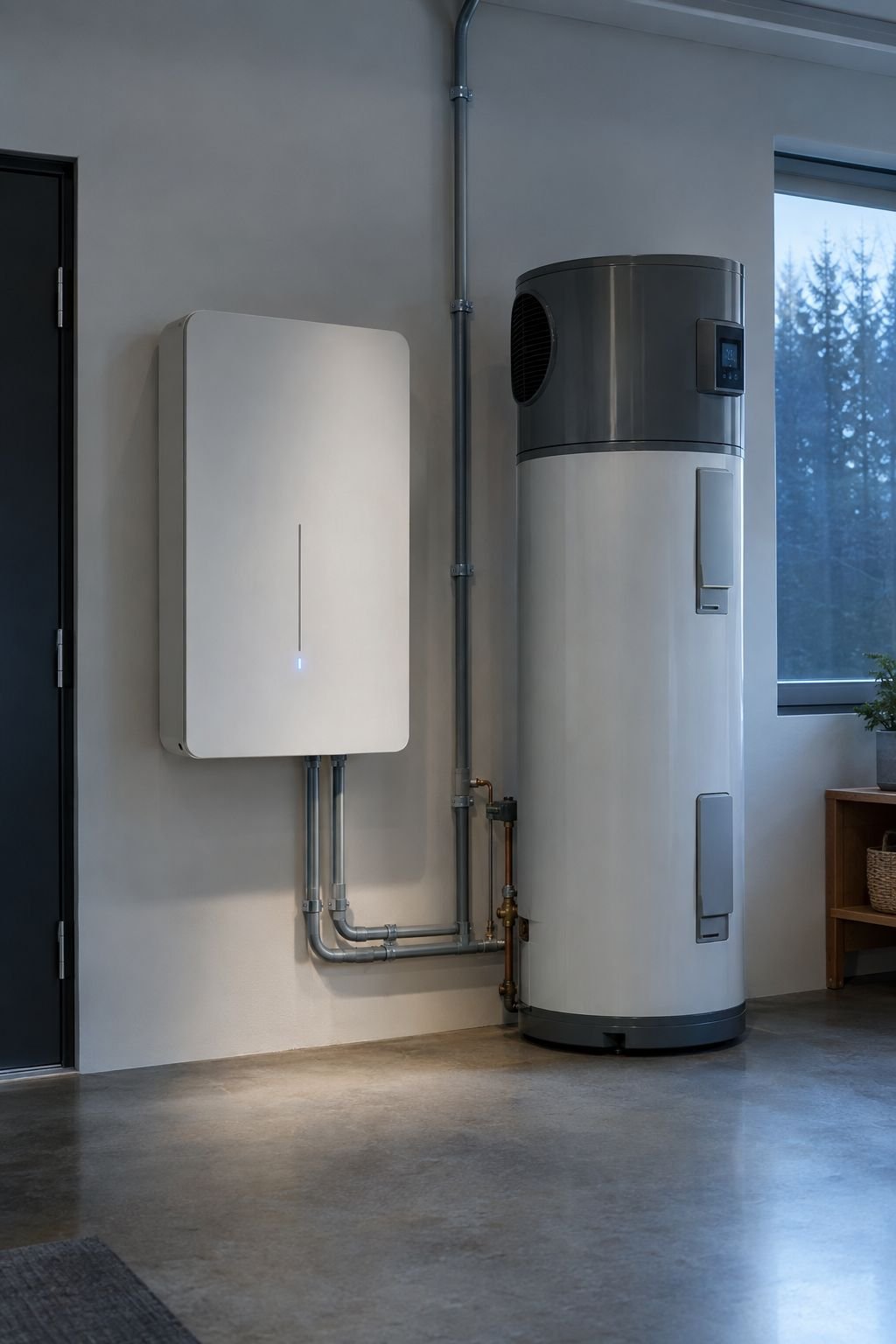 Two grid assets · one utility room
Follow the money
Who gets paid, and for what.
Program pay is built from a handful of value streams. Knowing which one a program pays for tells you how often you’ll be called, how reliable the money is, and how much the middleman keeps.
- Capacity — being available at peak, paid per kWLargest share
- Energy — kWh delivered during eventsEvent-driven
- Grid relief — avoiding local wire upgradesLocation-specific
- Time-of-use savings — shifting to cheap hoursOn your bill
- Upfront enrollment and device rebatesOne-time
- Aggregator’s share of the revenueOften undisclosed
Tools
Start with your ZIP code.
Calculator · Live
VPP Earnings Calculator
Enter a ZIP and battery size to see what each program in your state pays over 10 years, then add a thermostat, water heater, or EV for a whole-home total.
Directory · 62 programs
Find a Program
Every battery, EV, thermostat, water heater, solar, and commercial program we track, filtered to your state.
Directory · Platforms
Who Runs the VPP
The software companies, aggregators, and device makers that sit between you and the grid — and how each one gets paid.
Analysis
Read the economics.
VPP Economics
How VPPs make money — and how much reaches you
A kilowatt of flexibility can be worth $10 to $300 a year depending on who buys it.
Read →
VPP Economics
EV managed charging: a $475 grid asset paid $120–$400
Where the value of a managed EV comes from, and why drivers see less than half.
Read →
VPP Economics
Battery VPPs: the same battery earns $1,800 or $11,000
Your ZIP code matters more than your battery. Seventeen programs compared.
Read →