VPP money trail · per kW of capacity
Who gets paid when a virtual power plant answers a PJM event
Follow one two-hour demand response event from electricity customers to PJM, the aggregator, the device platform and 2,000 battery owners, in dollars and shares.
VPP Economics has no affiliation with, sponsorship from, or endorsement by any utility, aggregator, platform, or device maker named here.
The short answer
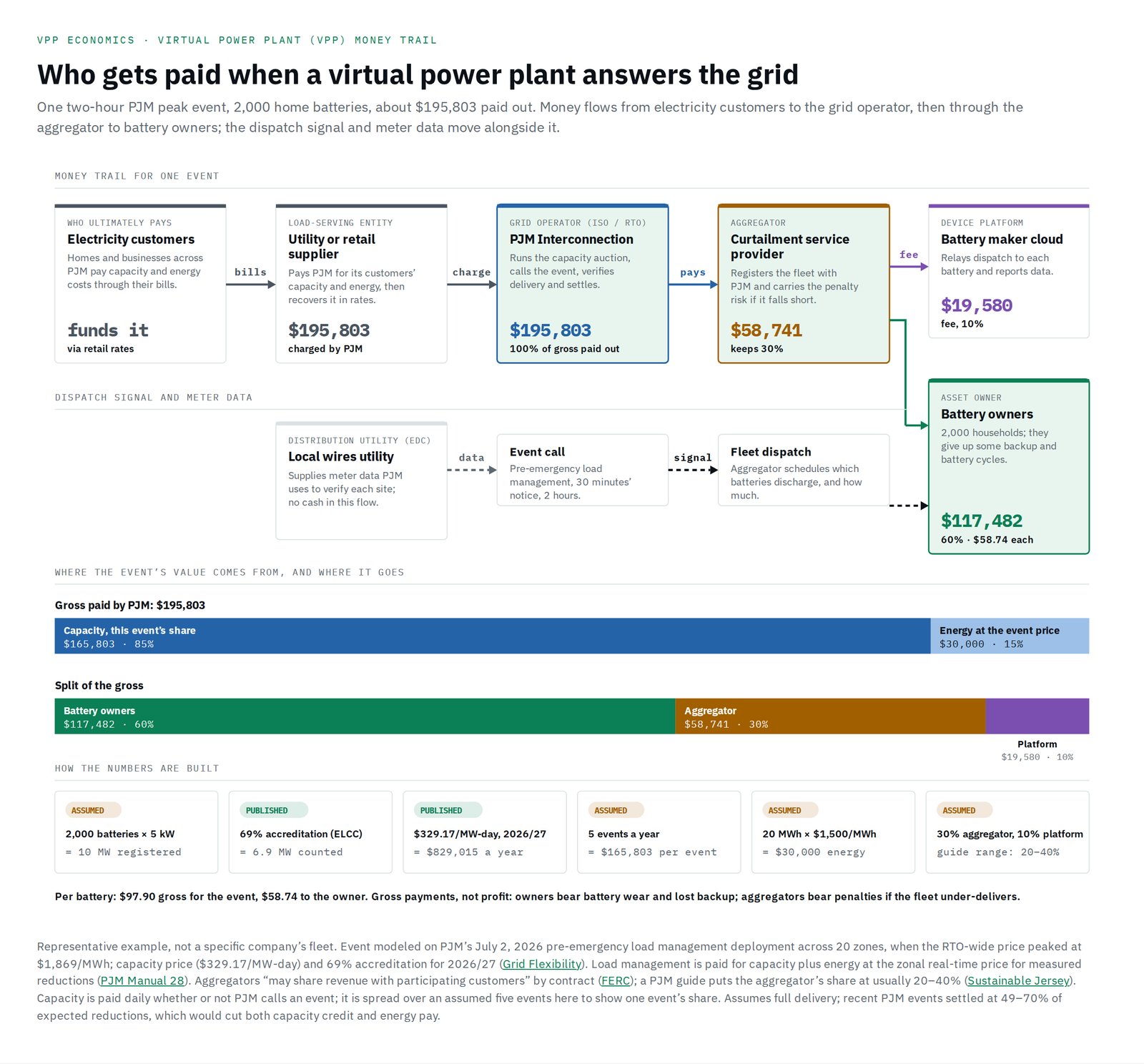
- One two-hour PJM event pays about $195,803 gross for a 10 megawatt (MW) virtual power plant (VPP) of 2,000 home batteries. About 85% of that is capacity, priced per kW; the rest is energy at the event price.
- PJM pays the aggregator, not the battery owner. The aggregator (a curtailment service provider) shares revenue by private contract. In this example owners receive 60%, or $58.74 per battery for the event.
- This is one-way, event-based demand response (DR): a few calls a year, a signal that only goes out, and delivery checked afterward from meter data.
- Utility-run programs skip the market. In ConnectedSolutions in Massachusetts and Rhode Island, the utility pays battery owners directly per kW, about $275 per kW per summer (DOE Liftoff).
Money trail for one PJM demand response event
Who pays whom, in dollars and shares, for one two-hour pre-emergency event. Representative fleet; inputs marked published or assumed.
Swipe to see the full chart →
Step by step
- Electricity customers across PJM fund the payment through capacity and energy charges in their retail rates.
- Load-serving entities — utilities and retail suppliers — are billed by PJM for their customers’ capacity and energy and recover it in rates.
- PJM clears the capacity auction a year or more ahead, calls the event on the day, and settles afterward. Load management is paid for capacity plus energy at the zonal real-time price for measured reductions (PJM Manual 28).
- The aggregator registers the fleet, carries the penalty risk if it falls short, and keeps a share. Under FERC Order 2222, aggregators “may share revenue with participating customers” as their contracts specify (FERC).
- The device platform — usually the battery maker’s cloud — relays dispatch to each battery and reports data. Its fee is rarely published; 10% is an assumption.
- Battery owners receive their share as a payment or bill credit, and give up some backup reserve and battery cycles in return.
- The local wires utility moves no cash in this flow but supplies the meter data PJM uses to verify each site.
Capacity is the real product
The event itself is worth far less than the promise to show up. PJM pays capacity every day of the delivery year whether or not it calls an event, so a 10 MW fleet accredited at 69% earns about $829,015 a year at the 2026/27 price (Grid Flexibility). Spreading that over an assumed five events gives each event’s share. Fewer events make each one look more valuable; they don’t change the annual total.
Accreditation is rising to 92% for 2027/28, which would lift the same fleet’s capacity value by about a third. Performance cuts the other way: recent PJM events settled at 49–70% of expected reductions, and capacity credit and energy pay both fall with under-delivery (Grid Flexibility).
What it means
Utilities and retail suppliers
They pay for this flexibility through capacity charges either way. Fleets that perform reliably can lower the capacity they must buy, and meter data is their main operational role.
Program managers
Per-kW pay rewards size and reliability, not event count. Publishing the owner share and penalty terms helps enrollment, because owners can’t see the market price behind them.
Aggregators
The margin is in accreditation and performance. A fleet that delivers 70% instead of 100% loses capacity credit and energy pay together.
One-way event versus two-way orchestrated
Demand response event
A handful of calls a year, a dispatch signal that only goes out, and performance checked afterward against a baseline built from meter data. Most of the value is capacity, paid per kilowatt (kW) for being available.
Market-traded fleet
Dispatched every five minutes, every day, with live telemetry flowing back to the grid operator. Most of the value is energy bought cheap and sold dear, plus reserves; Texas has no capacity market.
See the two-way orchestrated money trail → Or see how a per-kilowatt-hour program pays in the PG&E emergency program money trail →
All six money trails
PJM demand response event
You are here. Capacity is most of the value; owners get a contract share.
This pagePer kWh · one-wayPG&E emergency event
$2 per kWh delivered, passed through to owners.
See the money trail →Flat per devicePSEG Long Island thermostats
$25 a year per device, however many events.
See the money trail →Time-of-use · no programSCE battery on a TOU rate
Bill savings from a price signal, not a dispatch.
See the money trail →Hosted hardwareBase Power home battery
The company owns the battery and keeps the grid value.
See the money trail →Two-way · orchestratedERCOT market-traded fleet
Traded every day; owners get a fixed credit.
See the money trail →Method and caveats
Representative example, not a specific company’s fleet. Capacity is annualized at 365 days and accreditation applied to registered MW; energy assumes the full 10 MW for two hours at an average $1,500/MWh, below the $1,869/MWh peak hour. Event count, aggregator share and platform fee are assumptions; contracts vary widely and are rarely published.
Gross program payments are not net profit: owners bear battery wear and lost backup, and aggregators bear penalties and operating costs. Checked October 16, 2026.