VPP money trail · flat per device
Who gets paid a flat fee per smart thermostat
Follow one summer of PSEG Long Island’s Smart Savers program from Long Island customers to the utility, EnergyHub and 67,117 thermostat owners, and what the grid gets back.
VPP Economics has no affiliation with, sponsorship from, or endorsement by any utility, aggregator, platform, or device maker named here.
The short answer
- Flat-per-device programs pay a set amount for each enrolled device, not for each kilowatt delivered. PSEG Long Island’s Smart Savers thermostat program paid $85 to join and $25 a year to devices that took part in at least half of events (PSEG Long Island).
- In 2025 the program enrolled 67,117 thermostats and cost about $3.2 million, including incentives. Three three-hour events took 29.93 megawatts (MW) off the statewide peak hour, about 0.7 kilowatts (kW) per device.
- The payoff is a lower capacity bill. PSEG Long Island estimates that peak reduction cut its 2026 capacity costs by about $1,296,757; with other benefits, its utility cost test ratio was 1.03.
- This is event-based demand response (DR), not an orchestrated virtual power plant (VPP). The $25 is the same whether the grid calls one event or ten, and owners can override any event.
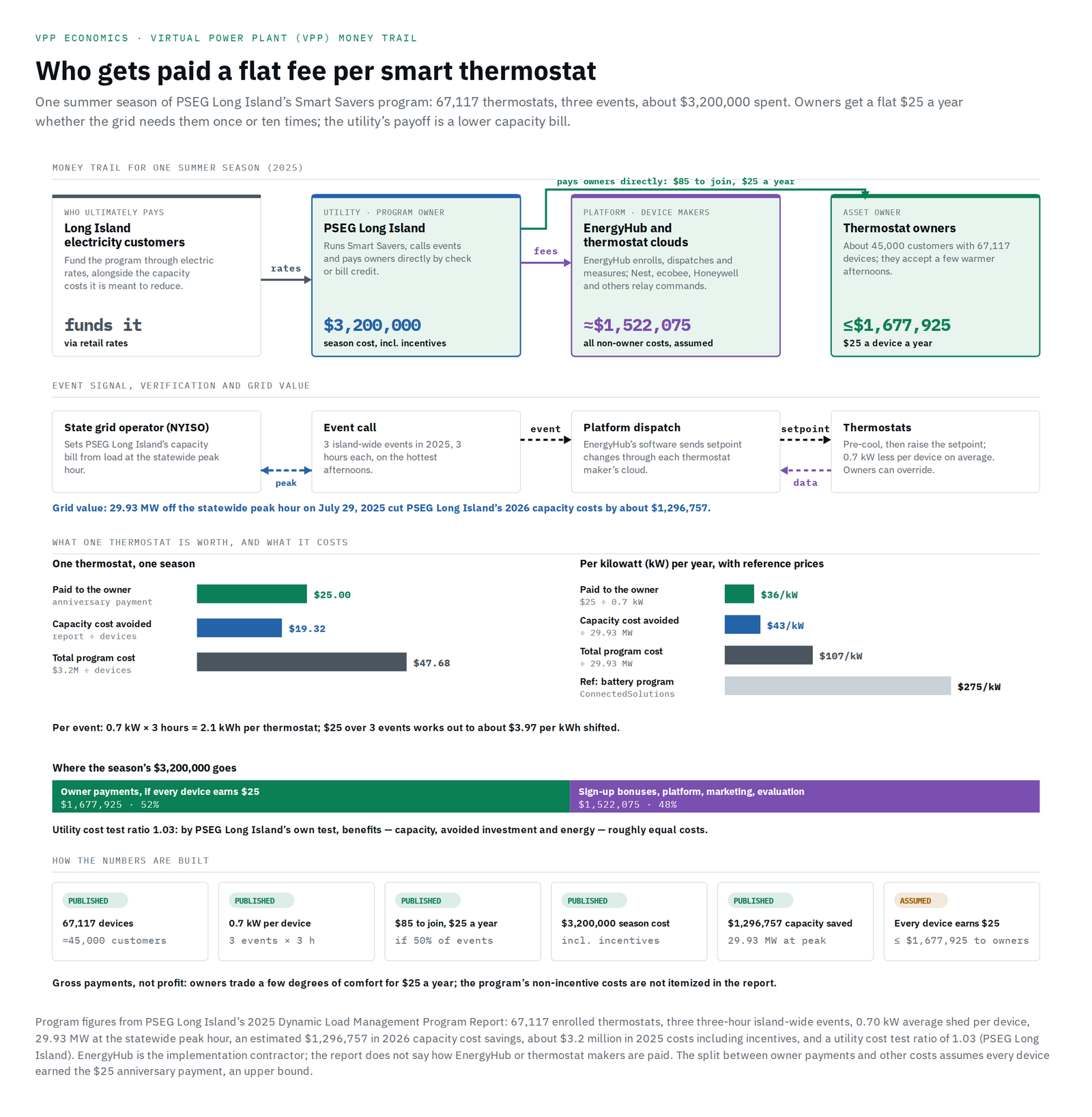
Money trail for one season of a flat-per-device thermostat program
Who pays whom for one summer of PSEG Long Island’s Smart Savers program, with the event signal and grid value. Inputs marked published or assumed.
Swipe to see the full chart →
Step by step
- Long Island electricity customers fund the program through rates. The same customers pay the capacity costs it reduces, so the test is whether savings exceed program spending (PSEG Long Island).
- PSEG Long Island, which runs the grid for the Long Island Power Authority, owns the program, calls the events and pays owners directly: $85 at enrollment and $25 on each anniversary if the device took part in at least 50% of events.
- EnergyHub implements the program on its Mercury distributed energy resource management system (DERMS). It enrolls devices, sends setpoint changes through each thermostat maker’s cloud and measures the results. The report does not say how EnergyHub or thermostat makers are paid.
- Thermostats pre-cool homes, then raise the setpoint for three hours. Average shed was 0.7 kW per device in 2025, down from 0.78 kW in 2024; owners can override.
- The state grid operator (NYISO) sets each utility’s capacity obligation from load at the statewide peak hour. Removing 29.93 MW at that hour on July 29, 2025 lowers PSEG Long Island’s 2026 capacity bill by about $1,296,757.
What a thermostat is worth here
Spread over 0.7 kW, the $25 payment is about $36 per kW a year; the whole program costs about $107 per kW and the capacity saved is worth about $43 per kW. Battery programs pay far more per kilowatt — ConnectedSolutions pays $275 per kW (Mass Save) — but each battery costs far more than a thermostat.
Per-device shed varies widely by climate and program design: NYSEG and RG&E reported 0.84 and 1.16 kW per thermostat (NYSEG and RG&E), SCE’s Smart Energy Program 0.92 kW (SCE), and ecobee cites about 0.65 kW across 143,000 devices (ecobee). A flat fee hides that spread from owners; the utility carries the performance risk.
What it means
Utilities
Flat fees are cheap to administer and easy to market, and thermostats enroll by the tens of thousands. The cost is fixed whether or not events are needed, so value depends on hitting the one peak hour that sets capacity costs.
Program managers
A pass-through to a platform such as EnergyHub keeps enrollment, dispatch and measurement in one place. Watch shed per device: a decline from 0.78 to 0.70 kW in one year cuts megawatts without cutting cost.
Aggregators
Thermostat fleets are large but shallow — under 1 kW each and limited to a few hours of comfort. They fit capacity-style DR well; they are less suited to daily, two-way market trading.
All six money trails
PJM demand response event
Capacity is most of the value; owners get a contract share.
See the money trail →Per kWh · one-wayPG&E emergency event
$2 per kWh delivered, passed through to owners.
See the money trail →Flat per devicePSEG Long Island thermostats
You are here. $25 a year per device, however many events.
This pageTime-of-use · no programSCE battery on a TOU rate
Bill savings from a price signal, not a dispatch.
See the money trail →Hosted hardwareBase Power home battery
The company owns the battery and keeps the grid value.
See the money trail →Two-way · orchestratedERCOT market-traded fleet
Traded every day; owners get a fixed credit.
See the money trail →Method and caveats
Program figures are from PSEG Long Island’s 2025 report (PSEG Long Island). The split between owner payments and other costs assumes every enrolled device earned the $25 anniversary payment, an upper bound; new devices got $85 instead, and some devices missed the 50% threshold. Per-kW figures divide by the 29.93 MW measured at the statewide peak hour.
Gross program payments are not net profit: owners accept warmer afternoons, and the capacity value accrues to all customers through lower rates. Checked October 16, 2026.