VPP money trail · per kWh delivered
Who gets paid per kilowatt-hour when a VPP answers a grid emergency
Follow one PG&E Emergency Load Reduction Program event from PG&E customers to the utility, the aggregator and 2,000 Powerwall owners, at $2 per kWh delivered.
VPP Economics has no affiliation with, sponsorship from, or endorsement by any utility, aggregator, platform, or device maker named here.
The short answer
- Per-kWh programs pay only for energy delivered during events. PG&E’s Emergency Load Reduction Program (ELRP) pays $2 per kilowatt-hour (kWh) of measured reduction, with no capacity payment and no penalty for falling short (PG&E).
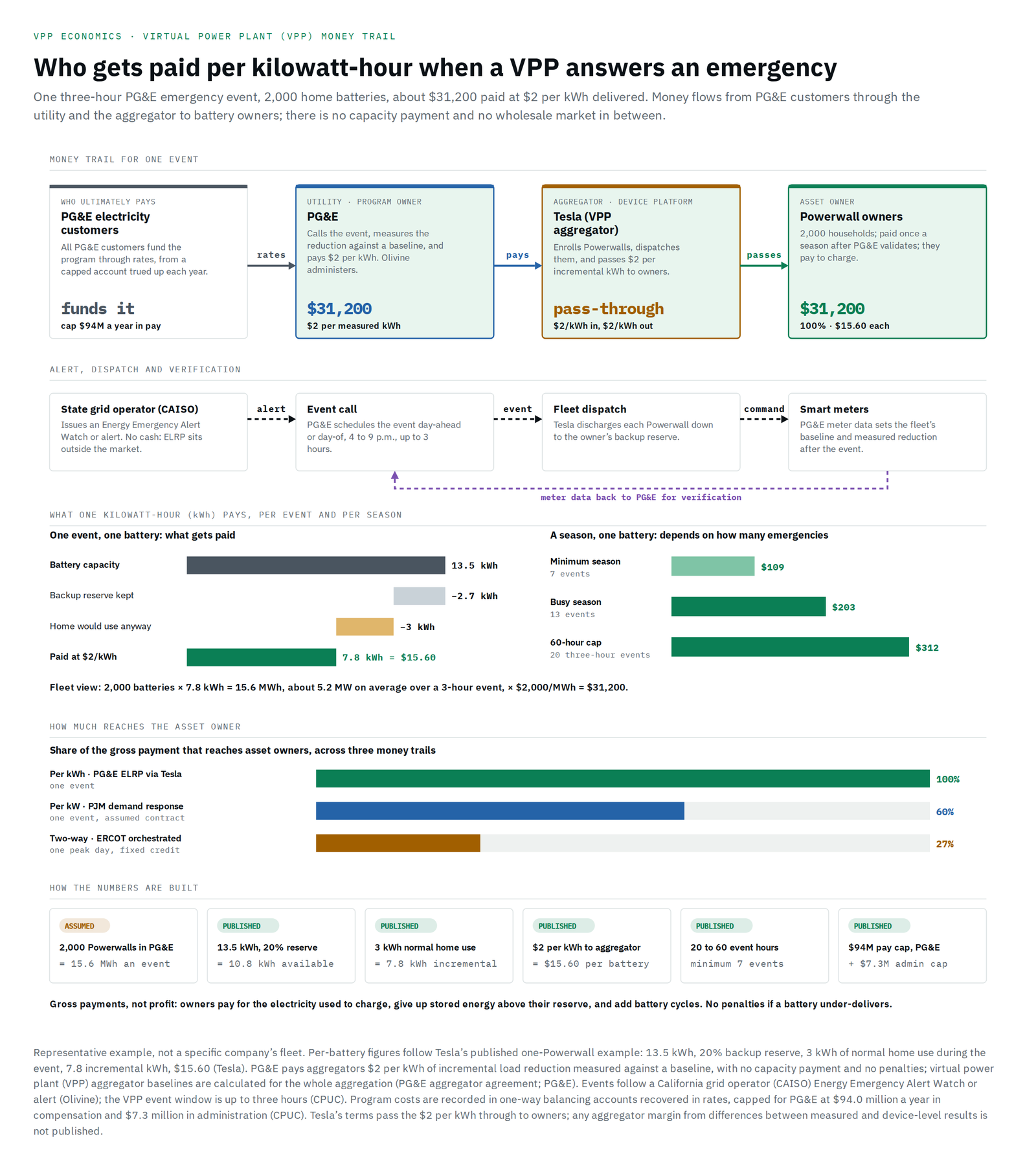
- One three-hour event with a 2,000-battery virtual power plant (VPP) pays about $31,200: 15.6 megawatt-hours (MWh), or about 5.2 megawatts (MW) on average, at $2,000 per MWh.
- Almost all of it reaches the owner. Tesla’s terms pass the full $2 per incremental kWh through, about $15.60 per Powerwall per event (Tesla), compared with 60% in the PJM example and 27% on the ERCOT peak day.
- It is event-based demand response (DR), not market trading. Events follow state grid emergency alerts, and the money comes from PG&E customers through rates rather than a wholesale market.
Money trail for one PG&E emergency event, paid per kWh
Who pays whom, in dollars and shares, for one three-hour ELRP event. Representative fleet; inputs marked published or assumed.
Swipe to see the full chart →
Step by step
- PG&E electricity customers fund the program. Costs are recorded in one-way balancing accounts and recovered in rates after annual true-ups, capped for PG&E at $94.0 million a year in compensation and $7.3 million in administration (CPUC).
- The California grid operator (CAISO) issues an Energy Emergency Alert Watch or alert. It pays nothing here; the program sits outside the wholesale market (Olivine).
- PG&E calls the event day-ahead or day-of, between 4 and 9 p.m. Events for VPP aggregators last up to three hours (CPUC). Olivine administers the program for PG&E.
- The aggregator — here Tesla, which is also the device platform — dispatches each Powerwall down to the owner’s backup reserve. The program’s minimum is 20 event hours a season, with up to 60 in a heavy emergency year (Tesla).
- PG&E measures the reduction against a baseline from smart-meter data. For VPP aggregators, the baseline is calculated for the whole aggregation (PG&E), and PG&E pays $2 per kWh of incremental reduction.
- Powerwall owners are paid once a season, after PG&E validates the results, for each kWh delivered beyond normal behavior. They pay for the electricity used to charge (Tesla).
What a kilowatt-hour is worth here
At $2 per kWh, ELRP pays $2,000 per MWh — a scarcity-level price paid on every event, whatever the market price that evening. Converted to capacity terms, a kilowatt that delivers for the program’s 20-hour minimum earns $40 a season, and $120 if all 60 hours are called. That is less than the $275 per kW ConnectedSolutions pays (DOE Liftoff), but there is no penalty risk.
Per battery, the season total depends on how many emergencies the grid has. Tesla estimates $100 to $450 per Powerwall a season (Tesla). Enphase gives a similar example: two 10 kWh batteries with a 20% reserve and 4 kWh of normal use deliver 12 credited kWh, or $24 an event (Enphase).
What it means
Utilities
Per-kWh pay is spent only when events are called, so a mild summer costs little. In return there is no firm capacity: participation is voluntary and unpenalized, so planners can’t count on a set number of megawatts.
Program managers
A simple, published rate makes the owner’s share easy to explain. The baseline is the hard part: owners are paid on device-level “beyond typical” energy, while utilities measure the whole aggregation against meter data.
Aggregators
With a full pass-through, the program itself earns the aggregator little directly. The value is in enrolling and keeping customers, selling hardware, and building a fleet that can later serve capacity or market programs.
All six money trails
PJM demand response event
Capacity is most of the value; owners get a contract share.
See the money trail →Per kWh · one-wayPG&E emergency event
You are here. $2 per kWh delivered, passed through to owners.
This pageFlat per devicePSEG Long Island thermostats
$25 a year per device, however many events.
See the money trail →Time-of-use · no programSCE battery on a TOU rate
Bill savings from a price signal, not a dispatch.
See the money trail →Hosted hardwareBase Power home battery
The company owns the battery and keeps the grid value.
See the money trail →Two-way · orchestratedERCOT market-traded fleet
Traded every day; owners get a fixed credit.
See the money trail →Method and caveats
Representative example, not a specific company’s fleet. Per-battery figures follow Tesla’s published one-Powerwall example; the fleet size and three-hour event length are assumptions, and real deliveries vary with state of charge, home load and export limits. Season totals multiply the one-event figure by event count; actual events vary in length.
Owner share assumes the aggregator’s measured reduction equals the device-level energy it pays for. Gross program payments are not net profit: owners bear charging cost, battery wear and lost backup. Checked October 16, 2026.