Utility program deep dive · Virginia
Dominion Energy Virginia C&I demand response and battery economics
Why data centers make Dominion’s territory a prototype for VPPs at scale, what curtailment pays against PJM capacity, and how a business battery pencils out on Schedule GS-2.
VPP Economics has no affiliation with, sponsorship from, or endorsement by any utility, aggregator, platform, or device maker named here.
The short answer
- The business programs are classic demand response. Non-Residential Curtailment pays $36 per kW-year for cutting at least 100 kW on 10–20 event days, and the Distributed Generation program pays $8.25 per kW-month to run backup generators. The 2027 VPP pilot adds a bring-your-own-device aggregator pilot that opens the door to third parties.
- The biggest flexible load in Virginia may be the data center. Dominion is already curtailing large new loads that accept non-firm service: more than 500 hours of curtailment in 2026 under its CAPFLEX pilot, one event lasting about 194 hours.
- Utility pay sits far below the market. PJM capacity clears at its cap, about $119 per kW-year, more than three times Dominion’s curtailment rate. A business must choose: Dominion’s program cannot be combined with PJM demand response.
- A business battery is a long payback today. On Schedule GS-2 demand charges, a hypothetical 100 kW / 400 kWh battery pays back in about 24.5 yr with curtailment pay, or about 16.2 yr if a provider passed through 60% of PJM capacity value.
Dominion, Virginia and PJM: who does what
Dominion Energy Virginia is vertically integrated, but it operates inside PJM, so a business in its territory has two ways to sell flexibility: to Dominion through its demand-side programs, or to PJM through a curtailment service provider. That is the key structural difference from Duke Energy Carolinas, where Duke’s own programs are the only buyer.
Three tracks
Where the money comes from, who sets the rules, and what reaches a business.
Swipe to see the full chart →
Programs by asset
Dominion Energy Virginia and PJM business flexibility options.
Swipe to see the full chart →
What makes Dominion different: the data center as the flexible load
Every deep dive on this site has one feature that changes how its economics read. For Dominion C&I it is scale. Most business VPP programs we cover are built around office HVAC, cold storage or a 100 kW battery. In Dominion’s territory the customer class that matters most for flexibility is data centers, which can each draw hundreds of megawatts.
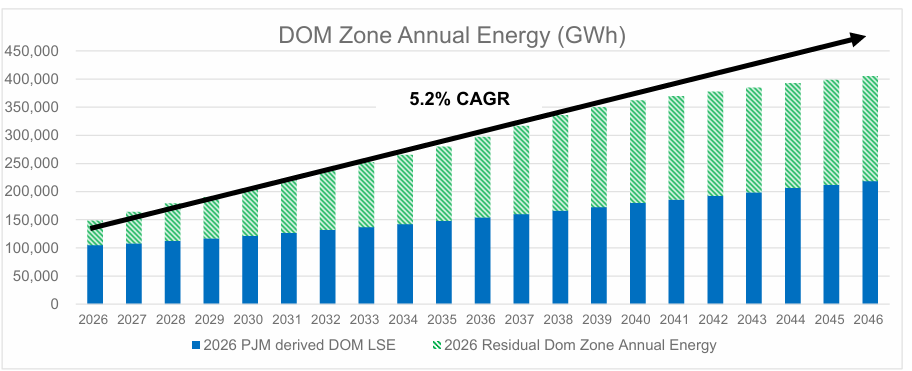
Load growth from the 2026 IRP
DOM Zone annual energy, 2026–2046, in gigawatt-hours.
Swipe to see the full chart →
The data center pipeline
Contracted data center capacity by contract stage, and the actual metered peak.
Swipe to see the full chart →
Dominion reports about 4 GW of data centers in Loudoun County, more than 20 GW of new data center load expected by 2031 and about 10 large-load requests a month (Dominion Energy). Where the transmission grid cannot yet serve them firmly, some customers accept non-firm service under its CAPFLEX pilot: 29 curtailment events and about 508 hours so far in 2026, the longest lasting about 194 hours. Dominion also counts 178 post-contingency local load relief warnings so far in 2026 (Dominion Energy).
Two lessons follow for smaller businesses. First, the value of flexibility in Northern Virginia is partly locational: a kilowatt reduced in a constrained load pocket is worth more than the same kilowatt elsewhere, and no current Dominion business program pays a locational premium. Second, data center backup generators are a large untapped resource, but Dominion’s VPP excludes fossil generation, so they stay in the separate Distributed Generation program.
What a flexible kilowatt is worth
Utility pay against the market
PJM capacity prices and Dominion’s per-kW business program pay.
Swipe to see the full chart →
Non-Residential Curtailment averages about $26,250 a year per participant (Dominion filing), which at $36 per kW implies sites of roughly 700 kW. Those sites could also sell through a PJM provider, where capacity at the cap is worth about $119 per kW-year before the provider’s share. Dominion’s program offers simpler terms and fewer events; PJM offers more money and more risk.
Building controls
$36 per kW-year, paid monthly; 10–20 events a year.
Rooftop HVAC
$75 to enroll and $40 a year under 400 kW, from 2027.
Battery
Schedule GS-2 demand savings plus curtailment or PJM capacity, not both.
Backup generators
$8.25 per kW-month for up to 120 hours a year; outside the VPP.
Solar with a battery
Pay for performance through an aggregator, under 5 MW, no double enrollment.
Stacking needs care, depending on M&V methodology. Dominion’s curtailment program and PJM demand response measure the same kilowatts, which is why they cannot be combined.
If the business adds a battery
Schedule GS-2, for sites of 30–500 kW, bills demand on the highest 30-minute interval of the month: $4.963 per kW for distribution, $1.971 for transmission and $1.803 for generation in summer, $0.588 in winter (Schedule GS-2). That is about $95 per kW-year before riders. Energy is not time-of-use priced, so a battery earns little from shifting.
Capital stack
Ten years of credit, savings and program pay as a share of cost plus ten years of maintenance.
Swipe to see the full chart →
Payback
Simple payback in years after the federal credit.
Swipe to see the full chart →
Own, borrow or buy a battery service
The GS-2 case with Non-Residential Curtailment. Money in and out of the site, then cumulative cash over 10 years.
Swipe to see the full chart →
The developer’s side
The site’s line above is only half of the deal. The developer pays the full $240k, carries maintenance, insurance and performance risk, and prices all of it into the contract to earn a return on its capital (Morgan Lewis). Third-party storage contracts usually run 15 years or more (Peak Power), and lenders treat 15- to 20-year terms as financeable (Illinois Power Agency). The chart below values each deal from the developer’s side.
What the developer earns
Present value of what the developer receives, as a share of what it spends, by contract terms.
Swipe to see the full chart →
With 25% of savings left to the site, a 15-year deal covers about 57% of the developer’s cost on our model, or about 65% if the battery earned 60% of PJM capacity value instead. At the modeled cost, a developer cannot earn 8% and still leave the site a share of bill savings. Battery-service offers are not priced the other way around, as a fee on top of handing over the savings: shared-savings providers promote a guaranteed share from day one (Gridwealth Electric), and Peak Power’s projects in Westchester, New York, split bill savings and market revenue with the building owner (NYSERDA case study). A deal that cannot fund a share is usually not offered at all. A guaranteed 15% share would need an installed cost about 75% lower, near $60k, well below today’s prices, so here a deal depends more on new program pay than on cheaper batteries; larger sites help, and providers such as Peak Power focus on facilities with more than 1 MW of load (Peak Power’s overview). The battery-service line above shows that 15% share. In Dominion territory today, a locational or capacity-linked payment is what would change that.
Why Dominion is ripe for more
A VPP readiness check
Eight conditions that make a territory ready for VPPs at scale, and Dominion’s status on each.
Swipe to see the full chart →
Launch in early 2027
Dominion expects the DSM-XIV programs, including the VPP pilot, to launch around the first quarter of 2027 and run through 2030 (Dominion filing).
15 MW of batteries by mid-2028
The SCC left budget flexibility so residential storage can reach 15 MW by July 1, 2028 (Advanced Energy United).
PJM Order 2222 in 2028
Dominion’s filing plans for PJM’s distributed-resource aggregation rules to go live in February 2028 (Dominion filing).
39 GW of new resources
The 2026 IRP update adds 39,244 MW by 2046, including 3,525 MW of storage and 8,965 MW of gas (Energy News Beat).
A typical bill up 57%
The IRP projects a typical 1,000 kWh bill rising from $180.31 to $283.65 a month by 2046 (Energy News Beat).
Appalachian Power’s own pilot
A separate law gives Appalachian Power a 150 MW VPP pilot in southwest Virginia (Code of Virginia).
Compare: ComEd C&I for another PJM zone where capacity costs reach the customer through a peak load contribution, and Duke Energy Carolinas C&I for a vertically integrated utility without a market.
Method and caveats
An independent, hypothetical analysis for business owners, facility managers, program designers, developers and other readers in Dominion Energy Virginia territory. Terms checked October 29, 2026.
Assumptions for the hypothetical battery: 100 kW / 400 kWh at $600 per kWh; $15 per kW-year maintenance; Schedule GS-2 base demand charges with 50 kW off the monthly peak and riders excluded; Non-Residential Curtailment at $36 per kW-year on 100 kW, assuming a battery qualifies; PJM what-if at 60% of the 2028/29 capped price on 100 kW. The developer figures price a 15-year third-party agreement at an 8% after-tax return.
Figures are gross savings and program payments before taxes on savings, financing and degradation. Gross payments are not net profit. Non-Residential Curtailment, the Distributed Generation program and PJM demand response are event-based demand response, not orchestrated VPPs. Stacking needs care, depending on M&V methodology.
VPP Economics has no affiliation with, sponsorship from, or endorsement by Dominion Energy, PowerSecure, Generac or any company named here.
Sources
Load growth, data centers and PJM
- Dominion Energy — 2026 Integrated Resource Plan update
- Energy News Beat — Dominion’s plan adds 39 GW of power
- Southern Environmental Law Center — Response to Dominion’s IRP
- Yahoo Finance — Dominion Energy Q2 2026 earnings
- Investing.com — Dominion Q2 2026 slides
- Stock Analysis — Dominion Q2 2026 call transcript
- PJM Load Analysis Subcommittee — Dominion Energy, September 2026
- PJM — Dominion load forecast documentation
- Dominion Energy — Operational realities of large load flexibility, September 2026
- Clean Air Task Force — Virginia’s uncertain energy future
- PJM Inside Lines — 2028/29 capacity auction results
- Utility Dive — PJM capacity auction at the price cap
- PJM — 2027/28 Base Residual Auction report
Virginia VPP law and pilot
- Code of Virginia — § 56-585.1:16, VPP pilot
- Code of Virginia — § 56-585.1:19, Appalachian Power pilot
- Utility Dive — Virginia leads with utility-scale VPP pilot
- Virginia SCC — Report RD623 (2026) on the VPP pilot
- Dominion Energy — Virtual Power Plant
- Dominion Energy — VPP pilot testimony, Schedule 1
- Advanced Energy United — SCC VPP order
- Advanced Energy United — Getting the VPP pilot right
- WHRO — Virtual power plants will launch soon in Virginia
- Solar United Neighbors and CEG — Value of a Virginia VPP
Dominion business programs
Business rates
Costs and finance
- Solar Cost Data — Energy tax credits in 2026
- Peak Power — Financing strategies for battery storage (third-party contract terms)
- Illinois Power Agency — Energy Storage Procurement Report (financeable contract tenors)
- Morgan Lewis — Shared-savings contract structures for energy storage
- Plante Moran — Battery storage investment tax credit after 2025
- Ferrius Energy — Storage depreciation and basis reduction