Utility program deep dive · Virginia
Dominion Energy Virginia residential VPP economics
How a state-mandated VPP pilot, the world’s largest data center market and PJM capacity at its price cap make Dominion a prototype territory, and what home devices earn today.
VPP Economics has no affiliation with, sponsorship from, or endorsement by any utility, aggregator, platform, or device maker named here.
The short answer
- Virginia’s VPP is past the planning stage. A 2025 state law required Dominion Energy Virginia to propose a virtual power plant pilot of up to 450 MW, the State Corporation Commission (SCC) approved it on August 3, 2026, and programs are expected to launch in early 2027.
- The programs are still mostly classic demand response. Today a home can earn $25 a year from Smart Thermostat Rewards, $40 from EV Charger Rewards or up to about $28 from Peak Time Rebates. The pilot adds a bring-your-own-battery program at $1,000 plus $294 a year.
- The territory is the story. Northern Virginia is the world’s largest data center market. Dominion’s 2026 IRP projects energy in its PJM zone growing 5.2% a year to 2046, PJM capacity is clearing at its price cap, and the Northern Virginia grid already runs under frequent local load relief warnings.
- Pay lags value, for now. The battery pilot pays about $50 per kilowatt a year, while PJM capacity clears at about $119. At pilot pay, a $20,000 battery pays back in about 64.6 yr; valued at the PJM cap, about 28.7 yr.
Dominion, Virginia and PJM: who does what
Dominion Energy Virginia serves most of central, eastern and Northern Virginia. Like Duke Energy Carolinas, it is vertically integrated: it owns the power plants, the wires and the meter. Unlike Duke, it sits inside PJM, the regional grid operator for 13 states and Washington, D.C., so its service area is also a PJM pricing zone, the DOM Zone, and its capacity is bought and sold in PJM’s auctions.
Three tracks
Where the money comes from, who sets the rules, and what reaches a household.
Swipe to see the full chart →
Virginia’s lawmakers, not only its regulator, set the direction here. The Community Energy Act of 2025 told Dominion to file a VPP pilot of up to 450 MW, with at least 15 MW of residential batteries and a path for third-party aggregators, ending July 1, 2028 (Code of Virginia). Dominion runs the pilot through one distributed energy resource management system (DERMS), Generac’s Concerto.
What makes Dominion different: a prototype territory
Every deep dive on this site follows the same template, but each has one feature that changes how its economics read. For Dominion it is not a program; the programs are still fairly standard. It is the territory. Dominion combines, in one service area, nearly every condition that should make a utility want flexible customer resources at scale: fast load growth, scarce and expensive capacity, local grid constraints, a legal mandate and the software to dispatch it. That makes it a preview of where other fast-growing territories are heading.
Load growth from the 2026 IRP
DOM Zone annual energy, 2026–2046, in gigawatt-hours.
Swipe to see the full chart →
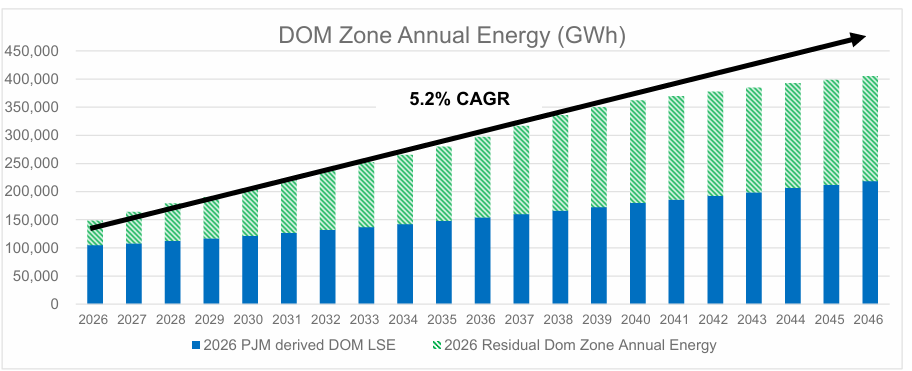
The driver is data centers. Northern Virginia, centered on Loudoun County, is the largest data center market in the world (PJM Load Analysis Subcommittee). Dominion’s contracted data center capacity reached about 53.8 GW in July 2026, up from 16.5 GW three years earlier (Investing.com), and nine of the DOM Zone’s ten highest peak days on record came in 2026 (Dominion’s Q2 2026 call). The 2026 IRP update, filed October 15, 2026, plans 39,244 MW of new resources by 2046 (Energy News Beat).
The data center pipeline
Contracted data center capacity by contract stage, and the actual metered peak.
Swipe to see the full chart →
Capacity is scarce across PJM, and the price shows it. The last three base residual auctions cleared at the price cap: about $120, $122 and $119 per kW-year for 2026/27 through 2028/29, and the 2028/29 auction fell about 6.8 GW short of its reliability target (Utility Dive). Without the cap, the 2028/29 price would have been about $202 (PJM). PJM expects about 32 GW of peak growth by 2030, more than 90% of it from data centers, with the DOM Zone the largest share (Clean Air Task Force).
What a flexible kilowatt is worth
PJM capacity prices against what Dominion pays per kilowatt today.
Swipe to see the full chart →
The local grid is tight too. Dominion reports about 4 GW of data centers in Loudoun County alone, 178 post-contingency local load relief warnings so far in 2026, and an average warning length that grew almost five times from 2023 to 2025 (Dominion Energy). That is the kind of constraint a VPP can relieve in specific neighborhoods, not just at the system peak.
The VPP pilot
From law to program
Key dates for the Dominion Energy Virginia VPP pilot.
Swipe to see the full chart →
Dominion counts about 54 MW of customer resources already tied to the VPP, from existing demand response, and plans a path to about 466 MW by 2030 (Dominion filing). The SCC approved seven demand-side programs for an initial phase of about 18 months (SCC). Advanced Energy United argued that compensation is too low to attract batteries at scale (Advanced Energy United).
What each device earns, and who pays
Programs by device
Dominion Energy Virginia residential flexibility programs, open today and planned for 2027.
Swipe to see the full chart →
One home, one payer
Annual program pay by device for one hypothetical Virginia home with a battery, an EV and a smart thermostat.
Swipe to see the full chart →
A home in every program would earn about $439 a year, almost all of it from Dominion. Battery events run 20–60 times in summer and 10–20 in winter, up to three hours each (Virginia Solar). Enrollment is one program per device: the pilot bars double enrollment (Dominion filing).
Home battery
$1,000 to enroll and $294 a year; 30–80 events a year, up to 3 hours.
Smart thermostat
$25 to enroll and $25 a year for joining at least 75% of events.
EV charging
$125 + $40 a year today; $40 + $10 a month in the pilot.
Rooftop solar
Excluded from the VPP because it is already compensated through net metering.
Solar, batteries and the “free” charge
Batteries are the most valuable single asset in the pilot, but VPP growth at scale will depend on several assets working together at each home. Virginia’s current design keeps them apart. Rooftop solar is excluded from the VPP because it is already paid through net metering (WHRO), and a battery owner on net metering would not receive a second credit for energy exported during events, a point Advanced Energy United has criticized (Advanced Energy United). Under monthly net metering at the retail rate, a kWh stored from the roof is worth no more than a kWh exported, the same position as Puget Sound Energy and the Duke Bridge in our Duke Energy Carolinas deep dive. Stacking needs care, depending on M&V methodology.
If the home adds a battery
Four ways to value the same battery
Annual pay for one battery delivering about 5.9 kW in events.
Swipe to see the full chart →
Capital stack
Ten years of incentives and pay as a share of a $20,000 installed battery.
Swipe to see the full chart →
Payback
Simple payback in years, before degradation and financing.
Swipe to see the full chart →
On today’s terms the battery case rests on backup power, not the pilot. The point of the other rows is the gap: if Dominion paid a home battery what PJM pays for capacity, the payback would fall by more than half, and on the value study’s numbers it would fall below ten years. Where Virginia settles between those rows is the decision that will shape its VPP after 2028.
Cash, a loan or a lease
Money in and out of the household, then cumulative cash over 10 years, on pilot terms.
Swipe to see the full chart →
Why Dominion is ripe for more
A VPP readiness check
Eight conditions that make a territory ready for VPPs at scale, and Dominion’s status on each.
Swipe to see the full chart →
Six of the eight conditions are in place, which is rare. The two missing pieces are design choices rather than physics: paying resources closer to their capacity value, and letting solar, batteries, EVs and thermostats at the same address work as one resource. Dominion’s IRP still adds gas alongside storage, and its pilot cost is small, about 20¢ a month for a typical customer, so the question for 2028 is scale, not concept.
Launch in early 2027
Dominion expects the DSM-XIV programs, including the VPP pilot, to launch around the first quarter of 2027 and run through 2030 (Dominion filing).
15 MW of batteries by mid-2028
The SCC left budget flexibility so residential storage can reach 15 MW by July 1, 2028 (Advanced Energy United).
PJM Order 2222 in 2028
Dominion’s filing plans for PJM’s distributed-resource aggregation rules to go live in February 2028 (Dominion filing).
39 GW of new resources
The 2026 IRP update adds 39,244 MW by 2046, including 3,525 MW of storage and 8,965 MW of gas (Energy News Beat).
A typical bill up 57%
The IRP projects a typical 1,000 kWh bill rising from $180.31 to $283.65 a month by 2046 (Energy News Beat).
Appalachian Power’s own pilot
A separate law gives Appalachian Power a 150 MW VPP pilot in southwest Virginia (Code of Virginia).
Related: the Duke Energy Carolinas residential deep dive for a vertically integrated utility outside PJM, the ComEd residential deep dive for another PJM zone, and the Dominion Energy Virginia C&I deep dive. To run other equipment, use the Residential VPP Calculator.
Method and caveats
An independent, hypothetical analysis for homeowners, renters, program managers, installers and other readers in Dominion Energy Virginia territory. Terms checked October 29, 2026.
Assumptions: one home battery at $20,000 installed, the value Dominion cites for a Powerwall 3; Battery Storage Pilot at $1,000 to enroll and $294 a year, implying about 5.9 kW at about $50 per kW. PJM capacity prices converted at 365 days a year. Pilot programs, prices and launch dates are as filed and approved and may change before launch. No bill savings, backup value or degradation modeled.
Figures are gross program payments before taxes, financing and degradation. Gross payments are not net profit. Peak Time Rebates, Smart Thermostat Rewards and EV Charger Rewards are event-based demand response; the VPP pilot dispatches devices through Dominion’s DERMS but is still mostly event-based. Stacking needs care, depending on M&V methodology.
VPP Economics has no affiliation with, sponsorship from, or endorsement by Dominion Energy, Generac, Tesla or any company named here.
Sources
Load growth, data centers and PJM
- Dominion Energy — 2026 Integrated Resource Plan update
- Energy News Beat — Dominion’s plan adds 39 GW of power
- Southern Environmental Law Center — Response to Dominion’s IRP
- Yahoo Finance — Dominion Energy Q2 2026 earnings
- Investing.com — Dominion Q2 2026 slides
- Stock Analysis — Dominion Q2 2026 call transcript
- PJM Load Analysis Subcommittee — Dominion Energy, September 2026
- PJM — Dominion load forecast documentation
- Dominion Energy — Operational realities of large load flexibility, September 2026
- Clean Air Task Force — Virginia’s uncertain energy future
- PJM Inside Lines — 2028/29 capacity auction results
- Utility Dive — PJM capacity auction at the price cap
- PJM — 2027/28 Base Residual Auction report
Virginia VPP law and pilot
- Code of Virginia — § 56-585.1:16, VPP pilot
- Code of Virginia — § 56-585.1:19, Appalachian Power pilot
- Utility Dive — Virginia leads with utility-scale VPP pilot
- Virginia SCC — Report RD623 (2026) on the VPP pilot
- Dominion Energy — Virtual Power Plant
- Dominion Energy — VPP pilot testimony, Schedule 1
- Advanced Energy United — SCC VPP order
- Advanced Energy United — Getting the VPP pilot right
- WHRO — Virtual power plants will launch soon in Virginia
- Solar United Neighbors and CEG — Value of a Virginia VPP
Dominion residential programs
- Dominion Energy — Peak Time Rebates
- Dominion Energy — Save energy programs
- Greater Grid — Dominion Smart Thermostat Rewards FAQ
- EnergyHub — Dominion Smart Thermostat Rewards terms
- Greater Grid — Dominion EV Charger Rewards
- Virginia Solar — Dominion VPP and home batteries